ReflectiMate
A hybrid intelligence approach to thinking through big life decisions. ReflectiMate is a thinking assistant that asks rather than advises. It brings awareness of how your thoughts are structured, and you bring the reasons behind them, so the thinking and the decision stay yours.
Study 1, UMAP 2026
Adapting to how a person reflects
The problem
Big life decisions involve cognitive, emotional and intuitive thinking, and people differ in how they spread their attention across these. Drawing on several sources of judgment is associated with better decisions. However, most decision-support systems focus on cognitive reasoning, and LLM agents usually generate follow-up questions from the conversation history alone, without a model of the person’s reflection.
How it works
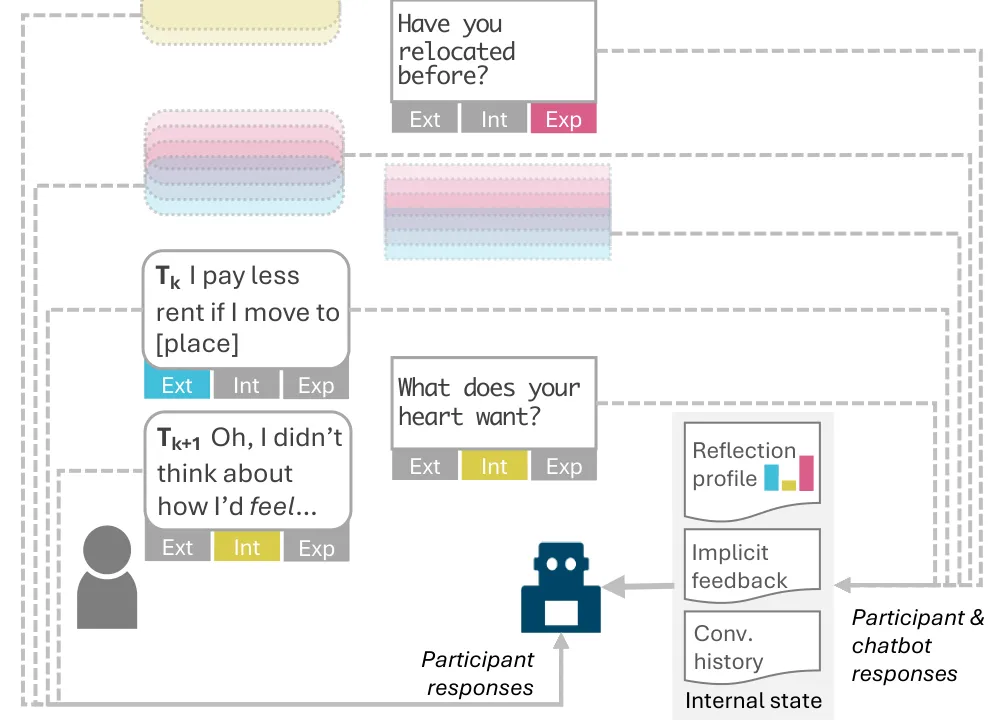
ReflectiMate builds a knowledge base of the person’s thoughts, starting from what they wrote before the conversation. Each thought is labelled internal (feelings, personal values), external (situational constraints, other people, factual information) or experiential (past experiences, prior outcomes), and details that deepen it are attached as elaborations. A coverage indicator per category adds breadth (number of thoughts) and depth (number of elaborations). The agent redirects toward the least explored category with exploration questions and deepens underdeveloped thoughts with Socratic follow-ups. It asks questions and never gives advice. We compared it with a baseline agent that used the same language model and objectives but had no model of the person’s reflection, in a between-subjects study with 128 participants.
Takeaways
- Good instructions are not enough. An agent with the same language model and the same goals, but no model of the person’s reflection, pushed everyone toward analytical thinking.
- Broaden without flattening. With ReflectiMate, people typically kept their own dominant way of thinking and added the ones they used less, instead of all converging on one style.
- People noticed the difference. More participants said ReflectiMate helped them bring head, heart and gut together. Both agents helped people elaborate equally well.
Please find the methodology and details in the paper.
Study 2, EMNLP 2026 Findings
Asking why before redirecting
The problem
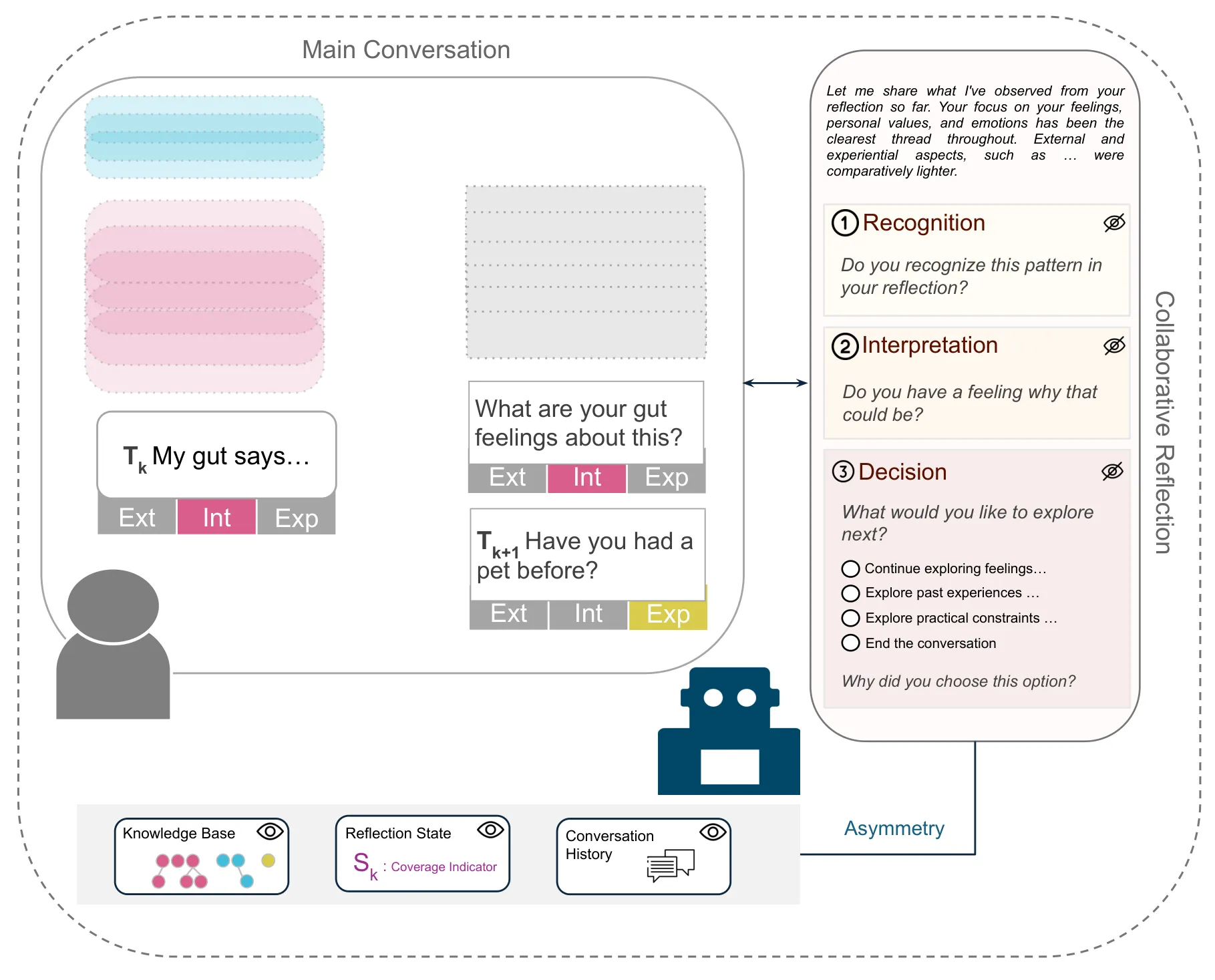
Adaptive agents map what they observe to an action. ReflectiMate, for example, reads high coverage in one category as fixation and redirects the conversation. However, the same observable pattern can have different reasons. We call the gap between the pattern an agent observes and the person’s reason for it the interpretive gap.
How it works
At each strategic decision moment, where ReflectiMate would normally redirect silently, a side panel opens. The agent shares what it has observed and the person answers three questions. First, recognition: do you recognise this pattern? Second, interpretation: why might that be? Third, decision: what would you like to explore next? The agent never reveals its own default choice. We studied 232 of these collaborative moments with 62 participants across 13 decision topics.
Takeaways
- Same pattern, different reasons. A focus that looks identical to the agent can be a deliberate choice for one person, an emotion for another and a thinking habit for a third. The agent cannot tell them apart. The person can.
- People can say why. Most people recognised the pattern the agent showed them and could explain it in their own words.
- Disagreeing on direction, not on exploring. People often chose a different direction than the agent would have. However, most still chose to move beyond the aspect they had focused on so far.
Please find the methodology and details in the paper.
Papers
Timeline
Reflecti-Mate: A Conversational Agent for Adaptive Decision-Making Support Through System 1 and System 2 Thinking
An agent that models how a person spreads attention across internal, external and experiential considerations and adapts its questions to broaden and deepen reflection.
Why This and Not That? A Collaborative Reflection Approach for Understanding Thought Coverage in Decision Making Support Dialog
The first empirical characterisation of the interpretive gap, with a 9-category taxonomy of the reasons people give for patterns an agent observes.
Who Decides When to Move On? Human and AI Steering Authority in Decision Making Support Dialog
Compares agent-led and user-led steering of the same reflection agent, and shows that who steers changes how reflection unfolds more than where it ends.
More papers will be added here as they come out.
Demos & talks
Where to see it
Upcoming
27 Oct 2026
PosterWhy This and Not That? A Collaborative Reflection Approach for Understanding Thought Coverage in Decision Making Support Dialog
EMNLP 2026 (Findings) · Budapest, Hungary
17 Nov 2026
DemoHands-on session with ReflectiMate
ICAI Exchange · Utrecht, The Netherlands
Past
11 Jun 2026
TalkReflecti-Mate: A Conversational Agent for Adaptive Decision-Making Support Through System 1 and System 2 Thinking
UMAP 2026 · Gothenburg, Sweden
17 Aug 2025
DemoHands-on session with ReflectiMate
Speech Science Festival, Interspeech 2025 · Rotterdam, The Netherlands
People
Who's behind it
- Lead
- Morita Tarvirdians
- Supervisors
- Catharine Oertel, Hayley Hung, Catholijn M. Jonker
Contact
Get in touch
Questions about ReflectiMate? Reach out via email.